
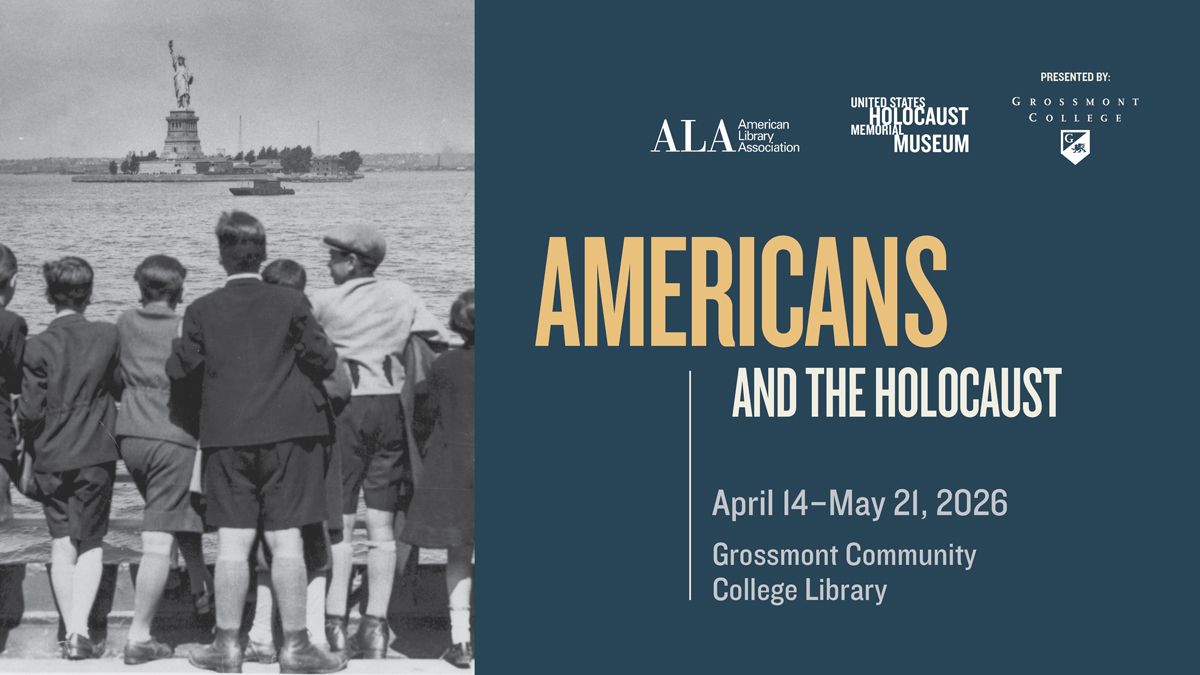
Grossmont College is bringing history to life for students and the East County community with the traveling exhibition Americans and the Holocaust.
Selected as one of just 50 libraries nationwide to host this prestigious program, the college will offer visitors an opportunity to explore how Americans responded to the rise of Nazism and the moral choices they faced during one of history’s darkest periods.
Grossmont was chosen through a competitive, peer-reviewed application process that considered community demographics, library outreach plans, and the availability of Holocaust-related educational opportunities in the region, according to Nadra Farina-Hess, Grossmont College librarian.
“The exhibit draws on a remarkable collection of primary sources from the 1930s and ‘40s, focusing on the stories of individuals and groups of Americans who took action in response to Nazism,” Farina-Hess said. “We hope to challenge people to not only ask ‘what would I have done?’ but also, ‘what will I do?’ regarding justice and combating indifference in their own communities.”
Alongside the exhibition, Grossmont College is hosting a series of programs and events to deepen engagement. Dr. Utgaard will discuss Japanese American incarceration during World War II, following a recent field study to Manzanar. Author Jennifer Coburn will examine propaganda through her novel Girls of the Glimmer Factory, and a panel of historians will introduce and lead a discussion following a screening of the documentary The United States and the Holocaust. Local Holocaust survivors will also share their stories, highlighting the continued relevance of this history in East County.
“We will also be highlighting the stories of local Holocaust survivors, to help underscore that the Holocaust is not just a distant chapter in history but a deeply local story,” Farina-Hess said.
The exhibition also complements Grossmont College’s broader mission to foster critical, historically grounded conversations about democracy, equity, and social responsibility.
“Through this program, students and community members can connect past choices to contemporary issues, enhancing civic awareness and historical thinking,” Farina-Hess said.
Hosting an exhibition of this size is a first for Grossmont College and requires careful planning and collaboration. Accessibility has been prioritized, with students translating a self-guided audio tour into ASL, Spanish, Arabic, and Dari, and recording it by the college’s Media Communication department. Partnerships with local organizations have also helped ensure high school students can attend.
“The response has been overwhelmingly supportive,” Farina-Hess said. “Students, faculty, and community members have expressed a strong interest in being involved. Programs like this encourage reflection on the impacts of prejudice and exclusion, and the shared responsibility to uphold human dignity across all communities.”