

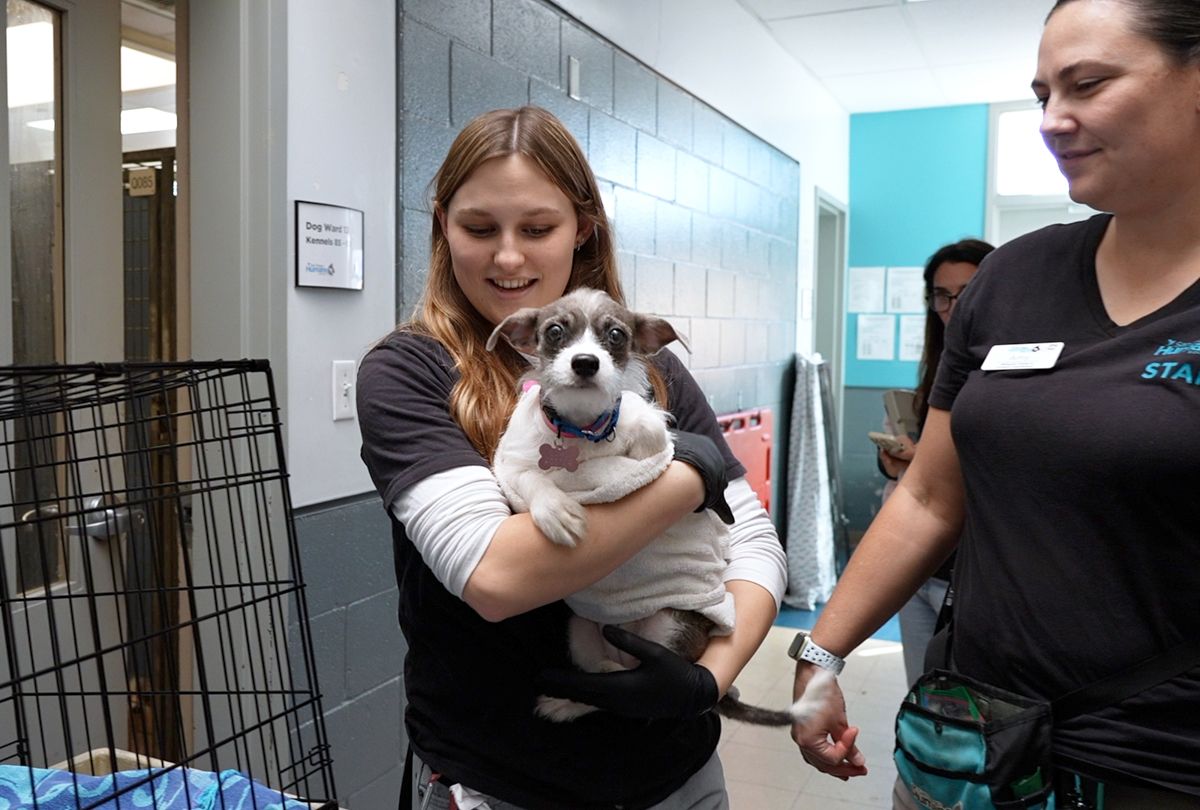
Seven of the 40 dogs and puppies rescued from a La Mesa apartment late last month have been placed into foster homes, a key milestone in a case that exposed severe living conditions and further strained San Diego Humane Society’s overcrowded shelters.
The rescue began on Dec. 29, when the La Mesa Police Department conducted a welfare check on a tenant who was facing eviction and had not been seen since Dec. 23. During the check, officers became concerned about the number of animals inside the apartment and the overall conditions and contacted San Diego Humane Society’s Humane Law Enforcement team.
“When our Humane Officers arrived that evening, they found 40 dogs and puppies living in feces and unsanitary conditions,” said Nina Thompson, director of public relations for San Diego Humane Society. “Because of the number of animals and the environment they were living in, officers ensured the dogs immediately had access to food and water, then coordinated a full rescue operation for the following day.”
On Dec. 30, Humane Society officers returned with veterinary and animal care teams to triage the dogs and transport them to the San Diego Campus. Each dog received a full medical exam, vaccinations, dewormer, and a microchip upon intake before being settled into kennels to decompress.
Medical teams focused first on identifying urgent concerns, including eye infections, skin issues, and signs of parasites, while also ensuring the dogs were hydrated and able to eat after coming from an unsanitary environment. Preventive care was started to protect both the rescued dogs and the other animals already in shelter care.
Behaviorally, many of the dogs were shy, fearful, and overwhelmed, Thompson said. Having been removed from a crowded and stressful living situation and then transported to a shelter, the dogs needed time and space to decompress. Animal care staff allowed them to settle in their kennels while beginning assessments to understand each dog’s comfort level around people and new stimuli.
Decisions about which dogs are ready for foster placement are made collaboratively by veterinary, behavior, and animal care teams. Some of the dogs now in foster homes are recovering from cherry eye surgery, while others exhibited fearful behaviors that could be better addressed in a quieter home environment.
One of the earliest foster placements occurred on Jan. 2, when a mother dog named Christie was reunited with her newborn puppies after staff were able to identify her during exams. The family has been in a foster home since then, where Christie can nurse and recover in a calm setting.
“These dogs all need to learn to trust humans, get socialized to the real world, and just be dogs who know love and touch,” Thompson said.
Two dogs, Clarke and Thoreau, arrived with severe eye ulcers, a painful condition that can threaten vision if left untreated. Both dogs were immediately placed on treatment plans that include medications to promote healing of the corneal surface, pain management, and frequent eye exams to monitor progress. While it is too early to determine a long-term prognosis, Thompson said the veterinary team is encouraged by how both dogs are responding to treatment.
The rescue occurred during an ongoing capacity crisis for San Diego Humane Society. On the day of the rescue, the organization had 725 dogs in care across its four campuses, including 600 adult dogs and 125 puppies. At that time, capacity levels were stretched to 171 percent at the Escondido Campus, 161 percent at the San Diego Campus, 160 percent at Oceanside, and 126 percent at El Cajon. To date, the total number of dogs in care stands at 748.
To manage overcrowding, some dogs are sharing kennels or occupying half-kennels, and warehouse spaces have been reconfigured to house emergency kennels. Those spaces lack proper drainage, making sanitation more challenging and increasing demands for staff.
With mass intakes, shelter staff often assign themed names to help track animals that arrived as part of the same case. In this instance, dogs were named after poets and authors, including Twain, Tolstoy, Brontë, Kafka, Atwood, Sappho, Woolf, and Camus.
For community members looking to help, Thompson said the most urgent need is foster homes for large dogs. Each foster placement frees up critical kennel space, reduces strain on staff, and provides dogs with individual attention that is difficult to offer in an overcrowded shelter. Donations are also needed to support medical and behavioral care and can be made at sdhumane.org/yearendrescue.
San Diego Humane Society provides an adoption guarantee for all animals and offers behavior and training support for adopters, particularly for dogs that are shy or fearful.
Adopters are briefed on each dog’s background and ongoing needs, with continued guidance available as the dogs adjust to life in new homes.